

Malignancy
Childhood malignancies frequently present with musculoskeletal symptoms and signs, and this must always be considered when assessing a child with joint pain, swelling or bone pain. National guidance (e.g. NICE guidance on suspected cancer in children or Cancer Research UK guidance) highlights the importance of considering malignancy in children presenting with musculoskeletal features. Malignancy must be excluded in any child presenting with arthritis, particularly before making a diagnosis of Juvenile Idiopathic Arthritis (JIA) and certainly before starting systemic corticosteroids.
Red flag features suggesting malignancy
Features that should raise concern include persistent or unexplained fever; systemic features such as weight loss, pallor, petechiae, lymphadenopathy, lethargy or hepatosplenomegaly; bone or back pain (particularly night pain); and pain out of keeping with clinical findings.
Leukaemia
Leukaemia is the most common childhood malignancy, with acute lymphoblastic leukaemia (ALL) being the most frequent type, typically presenting around 2–3 years of age. Musculoskeletal involvement is common, with arthritis or bone pain present in up to a quarter of children at diagnosis. Distinguishing leukaemia from JIA can be difficult as features such as fever or hepatosplenomegaly may overlap with inflammatory conditions.
Initial investigations include blood tests and imaging, but it is important to recognise that children with ALL may have normal or low white cell counts, a normal blood film, and no circulating blast cells early in the disease. Features that increase suspicion include pancytopenia (or involvement of two cell lines), lymphocyte predominance, raised ESR, and elevated LDH and uric acid. Where concern remains, a bone marrow aspirate is required to confirm or exclude the diagnosis.
Lymphoma
Lymphoma less commonly presents with musculoskeletal symptoms but bone pain and systemic features may occur. There can be overlap with systemic inflammatory disease (fever, malaise, lymphadenopathy, splenomegaly). Investigation includes blood tests and imaging, but definitive diagnosis requires lymph node biopsy.
Neuroblastoma
Neuroblastoma is the most common extracranial tumour in children, most often presenting under 5 years of age. Symptoms usually arise from mass effect or metastatic disease. Bony metastases are common and may present with limb or bone pain. Back pain in a young child is unusual and should always be taken seriously.
Bone tumours
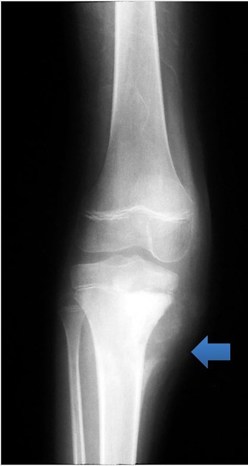
Bone tumours in children may be benign or malignant. Malignant tumours are rare but potentially life-threatening and must be identified early. Common sites include the distal femur and proximal tibia, so atypical or persistent knee pain should prompt further assessment. Radiographs should include the adjacent long bones above and below the joint.
Malignant tumours include osteosarcoma, Ewing’s sarcoma and chondrosarcoma (rare in children). Benign tumours include osteoid osteoma, osteoblastoma, non-ossifying fibroma and osteochondroma. Osteoid osteoma classically presents with night pain that responds to NSAIDs. Bone tumours may be detected incidentally on imaging or present with a pathological fracture.
Investigation and referral
Any child with suspicious features should be referred urgently via local pathways (paediatrics, orthopaedics or rheumatology). Referral should not be delayed while awaiting investigations. Radiographs will detect most bone tumours, but further imaging (MRI or CT) may be required to define the lesion, guide biopsy or assess for metastases.
Key presenting features of bone tumours
Typical presenting features include persistent or night bone pain, swelling of bone or soft tissue, systemic features such as lethargy or weight loss, and incidental findings on imaging or pathological fracture.
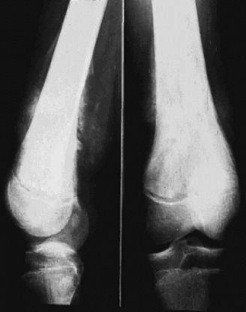
The MRI below shows a benign bone lesion in the distal femur
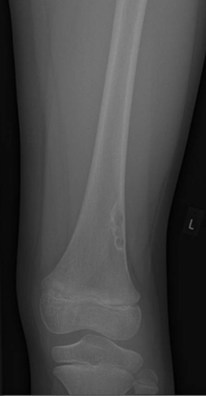
The radiograph below shows a malignant bone tumour in the distal femur (note the soft tissue swelling and irregular cortex)
The radiograph below shows the cortex changes and soft tissue swelling (arrow) of osteosarcoma in the proximal tibia